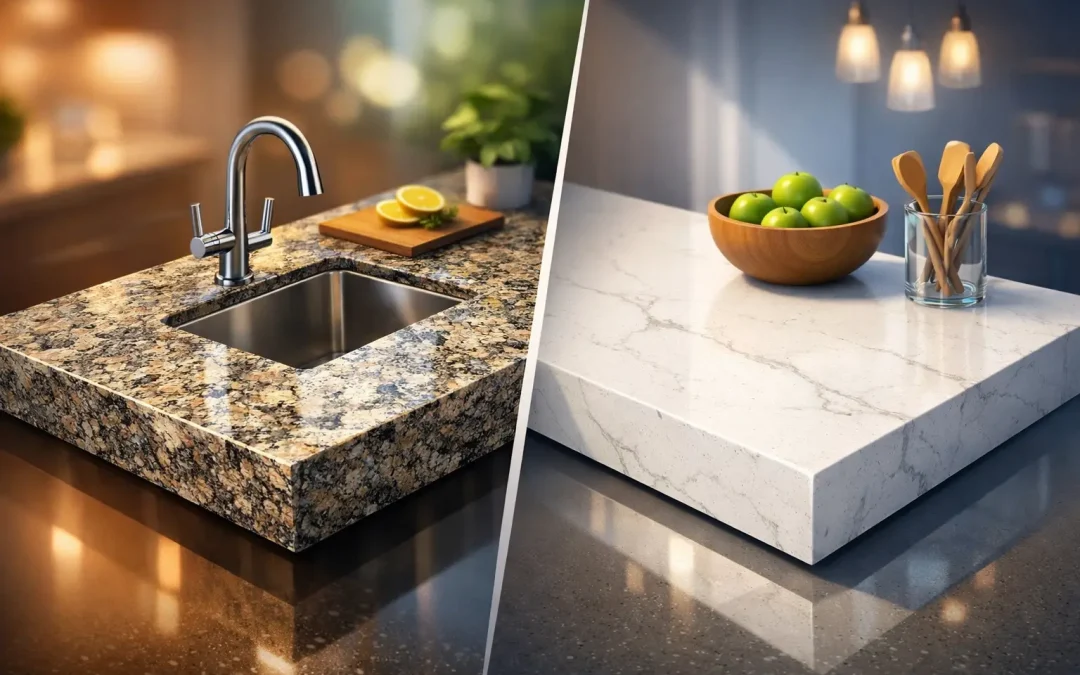
You usually feel this decision before you can explain it. One countertop looks warm and natural. The other looks clean, consistent, and easy to live with. When homeowners ask about granite or quartz countertops, they are usually not just picking a surface. They are deciding how they want their kitchen to look, how much maintenance they want to deal with, and how hard they want that material to work over the next ten or twenty years.
Both are strong choices for a kitchen remodel. Both can add value, improve daily use, and give an older kitchen a more finished, updated look. The better option depends on your budget, your design style, and how you actually use your kitchen.
Granite or quartz countertops: what is the real difference?
Granite is a natural stone cut from slabs formed by the earth. Every piece has its own movement, mineral pattern, and color variation. That one-of-a-kind look is a big reason many homeowners still prefer granite, especially if they want a kitchen that feels custom and less manufactured.
Quartz is an engineered surface made from crushed stone and resin. It is designed to give you the look of stone with more control over pattern and color. Because of that process, quartz tends to have a more uniform appearance. Some styles mimic natural marble or granite, while others lean more modern and minimal.
In practical terms, the biggest difference is consistency versus variation. If you want a slab that is truly unique, granite has the edge. If you want a predictable look across the entire kitchen, quartz is often the easier fit.
How they compare in everyday use
Most homeowners are not choosing countertops based on geology. They want to know what happens when coffee spills, kids leave wet cups on the island, or a hot pan gets set down too quickly.
Quartz is non-porous, which means it resists staining better without sealing. It is one of the main reasons busy households like it. If your kitchen sees a lot of weekday traffic, meal prep, and general wear, quartz offers a little more peace of mind.
Granite is very durable too, but it is naturally porous. That means it needs sealing to help protect against moisture and stains. With proper installation and maintenance, granite holds up well for many years, but it does ask for a little more attention.
Heat is another area where the answer depends on your habits. Granite generally handles heat better because it is natural stone. Quartz is durable, but the resin in the material can be more vulnerable to high heat. In most kitchens, trivets and hot pads should be standard practice either way, but granite gives you a bit more forgiveness.
For scratches and chips, both materials perform well in normal use. Neither is indestructible. Edge profiles, slab thickness, and installation quality all matter here. A well-installed countertop often performs better over time than a rushed install with a premium material.
Cost matters, but so does what is included
Homeowners often assume one material is always cheaper than the other. In reality, pricing can overlap quite a bit depending on color selection, slab availability, edge detail, cutouts, and backsplash work.
Entry-level granite can sometimes cost less than premium quartz. On the other hand, high-end granite slabs with dramatic movement or rare colors can cost more than many quartz options. Quartz pricing also varies based on brand, pattern complexity, and thickness.
The better way to think about cost is total project value. Countertops are not just the slab. You are also paying for measuring, fabrication, delivery, sink cutouts, polishing, installation, and in some cases removal of the old surface. If cabinets are not level or the layout has unusual angles, that can affect labor too.
For many Modesto-area homeowners, the smartest move is not chasing the lowest material price. It is choosing the surface that fits the kitchen, the budget, and the level of upkeep they are comfortable with after the project is done.
Which looks better in your kitchen?
That depends on the rest of the room.
Granite often works well in kitchens where homeowners want warmth, depth, and natural variation. It pairs nicely with wood cabinetry, traditional styles, and transitional designs that need some movement to keep the space from feeling flat. If your cabinets are a solid painted color and you want the countertops to bring personality, granite can do that well.
Quartz often shines in kitchens that are leaning cleaner and more contemporary. It is a strong match for white shaker cabinets, flat-panel doors, and designs where consistency matters. If you want a bright, polished look without a lot of visual interruption, quartz usually makes that easier.
There is also a middle ground. Some quartz designs have enough variation to soften the engineered look, and some granite colors are subtle enough to feel calm and refined. Samples help, but full slabs tell the real story. Lighting, cabinet color, wall paint, and flooring all change how a countertop reads once it is in the room.
Granite or quartz countertops for resale value
Both materials are viewed positively by buyers. In most cases, the bigger resale factor is not whether you chose granite or quartz. It is whether the kitchen looks cohesive, updated, and professionally finished.
A dated kitchen with mismatched finishes will not be rescued by expensive counters alone. But a well-planned remodel with quality countertops, functional cabinetry, and a clean installation can make a strong impression. Buyers tend to notice condition, style, and maintenance more than the technical differences between the two materials.
If resale is part of the conversation, neutral colors usually have broader appeal. Bold patterns and trendy looks can work beautifully in the right home, but they may narrow the audience later. This is where practical design guidance matters. The goal is usually to improve your daily life now without boxing in your options later.
Maintenance: how much do you want to think about it?
This is where many homeowners make the final call.
Quartz is the easier material for people who want a low-maintenance surface. It does not need sealing, and routine cleanup is simple with mild soap and water. For many families, that convenience is enough to justify the choice.
Granite is not difficult to own, but it is a little more hands-on. Periodic sealing helps preserve the stone and protect it from staining. Some homeowners do not mind that at all, especially if they love the natural character of granite. Others would rather install the top and not think about it again beyond normal cleaning.
Neither surface should be treated carelessly. Harsh chemicals, standing water around seams, and impact at corners or edges can create problems over time. Good habits make a difference no matter which way you go.
When granite makes more sense
Granite is often the right pick when you want natural beauty and do not mind a little maintenance in exchange for it. It also makes sense when you want a countertop with stronger heat resistance and a slab that feels unique to your home.
For homeowners who appreciate variation in color and veining, granite can feel richer and more custom. In older homes, that natural look can also blend especially well with character details that would feel slightly out of place next to a very uniform surface.
When quartz makes more sense
Quartz is often the better fit when ease of care is high on the priority list. It is a smart choice for busy households, cleaner-lined kitchen designs, and homeowners who want consistency across a large island or long run of cabinets.
It also tends to work well when the design goal is controlled and coordinated. If you already have movement in the backsplash, flooring, or cabinet grain, quartz can balance the space instead of competing with it.
The installation matters as much as the material
A countertop can be beautiful in the showroom and disappointing in the kitchen if the installation is not handled properly. Accurate templating, clean seam placement, solid support, level cabinets, and careful finishing all affect how the final result looks and performs.
This is especially important in remodels where older homes may have uneven walls, existing cabinetry issues, or layout changes. A good contractor helps you think through the full picture, not just the slab sample. That includes how the countertop meets the backsplash, how the sink is mounted, whether the overhang is properly supported, and how the material fits with the rest of the remodel.
That practical guidance is often what saves homeowners from costly mistakes. Thiel Construction works with homeowners who want that kind of straightforward help – not just picking materials, but making sure those materials make sense for the space, the budget, and the way the kitchen is used.
If you are still deciding between granite and quartz, the best answer may come from looking at your own priorities instead of trying to find a universal winner. Think about how much maintenance you want, how much variation you like, and whether your kitchen needs warmth, consistency, or a bit of both. The right countertop is the one that still feels like the right choice after the remodel dust settles.
Recent Comments