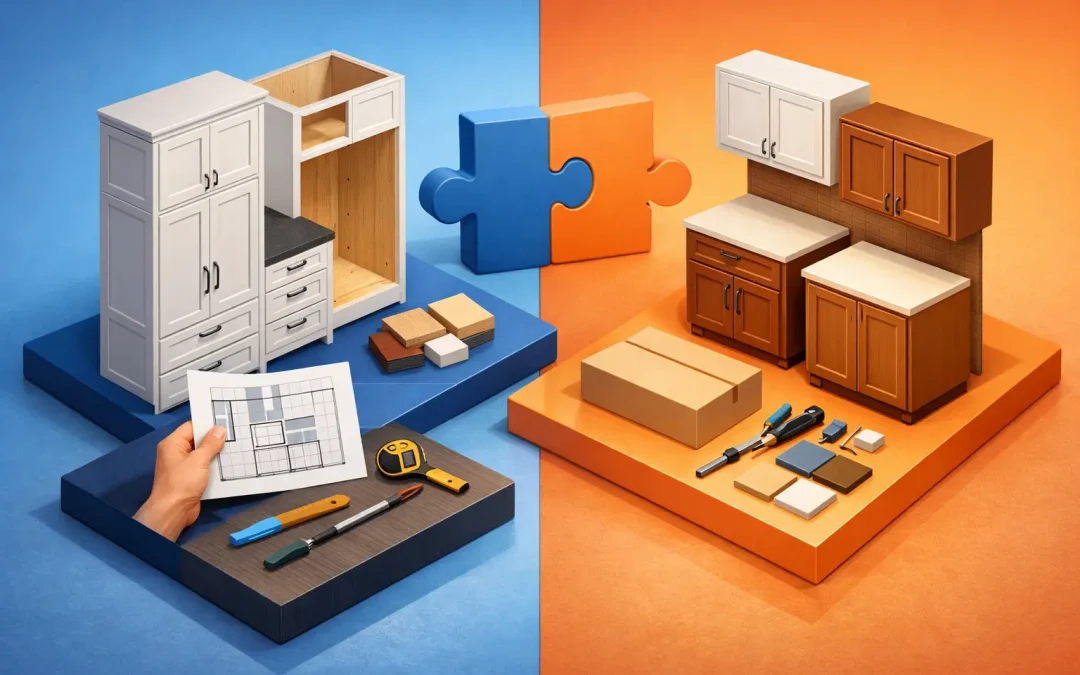
A kitchen can look fine on paper and still feel wrong once the cabinets go in. That usually happens when homeowners are forced to design around cabinet sizes instead of designing cabinets around how they actually live. When you are weighing custom cabinets vs stock, the real question is not which one is better in every case. It is which one makes the most sense for your space, your budget, and how long you plan to stay in the home.
For some homeowners, stock cabinets are the smart move. For others, custom cabinetry solves problems that off-the-shelf options simply cannot. The right answer depends on layout, priorities, and where you want the money to work hardest.
What custom cabinets vs stock really means
Stock cabinets are pre-made in standard sizes, styles, and finishes. They are built for quick ordering and faster installation, which makes them popular for straightforward remodels and budget-conscious updates. You are choosing from a catalog rather than building from scratch.
Custom cabinets are made to fit your specific kitchen, bathroom, laundry room, or built-in project. That means the cabinet dimensions, door style, wood species, storage features, and finish can all be tailored to the room. If your home has an unusual layout, older walls that are not perfectly square, or a design idea that does not fit standard sizes, custom work gives you more control.
That difference sounds simple, but it affects cost, appearance, function, and even how complete the finished room feels.
Cost is important, but it is not the whole story
Most homeowners start here, and for good reason. Stock cabinets usually cost less upfront. Manufacturing is standardized, materials are often selected for efficiency, and lead times can be shorter. If your goal is to refresh a room without stretching the budget too far, stock cabinets may give you the best value.
Custom cabinets cost more because they require more labor, more planning, and more shop time. You are paying for fit, flexibility, and craftsmanship. That does not automatically mean custom is overpriced. In some remodels, custom cabinetry prevents expensive compromises later, especially when a standard cabinet plan leaves awkward gaps, wasted corners, or storage that does not really work.
A lower purchase price can still lead to a less satisfying result if the room ends up feeling pieced together. On the other hand, paying for custom in a simple, standard kitchen may not deliver enough added value to justify the cost. This is where good planning matters more than assumptions.
When stock cabinets make the most financial sense
Stock cabinets are often the better fit when the room has a simple layout, the cabinet sizes line up well with standard options, and the homeowner wants a practical update without turning the project into a full redesign. They also work well in rental properties, secondary spaces, and homes where resale timing matters more than long-term personalization.
If your existing footprint works and you are mostly improving style, stock cabinets can free up budget for countertops, tile, lighting, or appliances.
When custom cabinets earn their price
Custom cabinetry starts to make more sense when the room has limitations that standard sizing cannot solve. Older homes often have quirks that show up quickly during remodeling. Uneven walls, tight corners, unusual ceiling heights, or layout challenges can make stock cabinets look like they were fitted in afterward rather than designed for the room.
Custom work can also be worth it if storage is a major concern. Deep drawers where you need them, tray storage near the range, a true pantry solution, or built-ins that make use of every inch can change how a room functions every day.
Fit and finish often decide how the room feels
This is where homeowners notice the difference most clearly. Stock cabinets come in set sizes, so installers often need fillers, panels, and adjustments to make everything work. That is normal, but too many workarounds can make the layout feel less intentional.
Custom cabinets are built to the room, so spacing can be cleaner and more balanced. You can carry cabinetry to the ceiling, align features more precisely, and make better use of narrow or awkward areas. The finished project tends to look more integrated because it was designed that way from the beginning.
That matters in kitchens especially, where visual lines and storage efficiency are tied closely together. A kitchen that fits the room well usually feels more expensive and more functional, even before you get into materials and details.
Quality depends on the product, not just the category
One common mistake is assuming all stock cabinets are low quality and all custom cabinets are high quality. That is not always true.
There are stock cabinet lines that offer solid construction and attractive finishes, and there are custom options that can be overbuilt for the needs of the project or priced beyond their practical value. The better comparison is in the actual materials, joinery, hardware, drawer construction, and finish durability.
With custom work, you generally have more control over those choices. You can often select stronger materials, better drawer glides, and features that match how you use the space. With stock cabinets, those decisions are more limited, but that does not mean the result cannot be durable and attractive.
A contractor with remodeling experience can help you compare actual cabinet quality rather than getting distracted by labels alone.
Design flexibility is where custom stands apart
If you already know what you want and it falls within standard options, stock may be enough. But once homeowners start asking for a very specific painted finish, a furniture-style island, special trim details, appliance panels, or cabinetry sized around a unique layout, custom becomes the more natural path.
This is especially true when the cabinetry is meant to solve both style and storage at the same time. A kitchen is not just a row of boxes. It has to work around cooking habits, traffic flow, family routines, and visual balance. Custom cabinets allow those decisions to happen together instead of treating function and appearance as separate issues.
For homeowners in older Central Valley homes, that flexibility can be the difference between a remodel that looks acceptable and one that truly feels finished.
Installation timeline can shift the decision
Stock cabinets often win on speed, at least in theory. Because they are already manufactured, ordering can move faster if the selected line is available and the layout is straightforward. That can help when a homeowner needs a quicker turnaround.
Custom cabinets usually require more lead time. Measurements have to be finalized, shop drawings may be reviewed, fabrication has to happen, and finishing takes time. If the project schedule is tight, that longer process may matter.
At the same time, a faster order does not always mean a faster overall project. If stock cabinets require multiple adjustments or compromise the layout, some of that time savings can disappear. A well-planned custom job can move very efficiently once production starts.
Resale value depends on the house and the neighborhood
Many homeowners ask whether custom cabinets add more resale value. Sometimes they do, but not always in a direct dollar-for-dollar way.
In a higher-value home or a kitchen where buyers expect a more tailored finish, custom cabinets can help the space stand out. They often contribute to the overall impression of quality, which can support resale appeal. In a more modest home, however, an attractive stock cabinet kitchen may be perfectly appropriate and financially wiser.
The best investment is usually the one that fits the home itself. Over-improving a house rarely pays the way homeowners hope. Neither does cutting corners in a room that clearly needs a better solution.
How to choose between custom cabinets vs stock
The smartest decision usually comes from a few honest questions. Is your layout simple or difficult? Are you trying to maximize every inch, or mainly update the look? Do you need a short timeline? Are you planning around a firm budget, or are you willing to spend more for a better long-term fit?
It also helps to think about frustration points. If your current cabinets waste space, make cooking harder, or fail to fit the room properly, custom may solve problems worth paying for. If your main goal is a clean, updated look with dependable function, stock may be the right answer.
This is where working with an experienced remodeling contractor matters. A good cabinet recommendation should be based on your home, not a one-size-fits-all sales pitch. In many projects, the best value comes from balancing custom elements with practical choices elsewhere.
Thiel Construction works with homeowners who want that kind of practical guidance, especially when cabinetry needs to support both design goals and everyday use.
There is no one right answer for every home
The custom cabinets vs stock decision is really about priorities. Stock cabinets can be a solid, cost-effective choice when the layout is straightforward and the budget needs to stay controlled. Custom cabinets make more sense when fit, storage, and design details are too important to leave to standard sizing.
A good remodel is not about spending the most. It is about making choices that fit your home and hold up to real life. If your cabinets are doing more than filling wall space, the right option tends to become clear once you look at how you actually use the room.
Recent Comments